

The Drill Team and Germany
by Jay Myrdal
The first time I walked into the orderly room the first Sargent nearly fell off his chair. I had just arrived in Pirmasens Germany.
Dark Clouds on the Horizon
Thirteen months earlier I had been sitting in the student union coffee shop at the University of Montana, playing Hearts. Now in my second year and still a freshman, I was discovering that drinking coffee and playing cards was preferable to attending lectures, especially if I hadn’t prepared for them. Though I didn’t realise it at the time, I was very dyslexic and found spelling and thus writing quite difficult. I had managed to cruise through High School with a passing grade without doing any homework, but university, it turned out, was not going to be so easy.
A new arrival at our table began to relate his recent experiences in the Far East; somewhere called Viet Nam. This was autumn 1962 and yes, we had heard a bit about Viet Nam. There was a conflict there, and our boys, only Special Forces advisors, were helping to protect the innocent people of South Viet Nam from the dirty commies in the North. My friend’s friend had just returned a few days earlier, and was quite excited about what he had seen, mostly unreported by the American press. He went on about it for some time, but the bottom line was:
“It is going to blow up big time over in Viet Nam” …
I was nineteen years old and so far, at least, protected from the draft by being in university and enrolling in the Reserve Officer Training Corps, the ROTC. The idea was that I would be deferred until I graduated and then be required to enter the military as an officer, but I could see that studying wasn’t really working out. At my present rate of gaining credits, it would take me nine years to graduate. I was also developing a very keen interest in photography which was beginning to take a lot of my time. I had been talking to another local who shared my photographic interests and showed off some of his high-end cameras and lenses. He kept telling me how cheaply one could buy cameras and such in Germany and France. The fact that he was also an Army recruiting sergeant should have alerted me to what was about to happen next.
I signed up, for three years. The draft was only two years, but the extra year bought a special option. Usually, people opted for a particular job like radar technician or motor mechanic, but one could also opt to be sent to a particular area of the world. The Far East had previously been considered a comfortable and romantic part of the world, but a serious change was apparently afoot, and I didn’t want to be part of it. Now my only option was obvious. “Europe Un-assigned” it said on my orders.
Campus in Khaki
The un-assigned bit meant that my army roll was yet to be decided. I did well in my ability tests so after basic training, instead of becoming a simple foot soldier, I was sent to a very pleasant army post known at the time as The Campus in Khaki – Fort Monmouth, New Jersey. My assigned MOS – Military Occupational Speciality, was “Crypto Maintenance”. Obviously, electronics or Mechanics of some sort and highly classified so, glory of glories, no work or study material was allowed out of the classroom. This could not have suited me better because I had hardly ever lifted a book or a pen outside of class in High School. I just managed to absorb enough during school time to achieve a passing grade. Now in this classroom, because we could not study outside the building, the lessons were repeated, over and over again, quite tediously, until everyone understood. It was also, for the most part, very logical, being largely maths and mechanics which suited me too so It was very easy for me to retain the material.
Being assigned no homework left plenty of time for other activities but sadly most of them cost money, and a poor army private had little of that. I hadn’t been there more than a day or two when I noticed several students wearing very impressively spit shined boots and very crisply ironed fatigue uniforms. I must admit here that I was more than a little “Gung Ho” in my youth. I had risen to cadet commander in my little Civil Air Patrol unit in Missoula, Montana, and I was attracted to this glamourous and somewhat extreme military style.

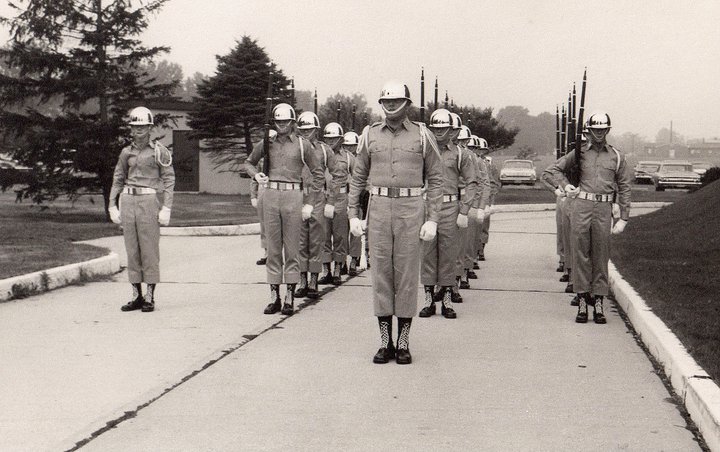
The Fort Monmouth Drill Team & Honour Guard
The Fort Monmouth Drill Team & Honour Guard was a street marching drill team with a unique style. It was entirely made up of Signal Corps Students. The routines, although impressive and quite complex looking, were actually fairly simple. They amounted to variations on a repeatable formula and were easy to learn. We were not the world’s best drill team of course, but were a good tight unit none the less. We spun our rifles and marched our spit-shined boots through various cities and events in the area during the next year, including performing in the famous St. Patricks Day parade in New York City.
Membership of this unit came with several privileges, the best of which was “No Bed Check”. This meant that, unlike most of the other student solders on the post, we could stay out all night if we wanted to. Not that we had much time for going out; maintaining the uniform and boots was a very labour-intensive task. I became an expert at spit-shinning spending many hours with a ball of cotton wool and a dish of water, carefully going over and over the glassy black mirror surface that my boots had taken on. My boot laces were done up in what we called a spider web pattern; black for every day and white for dress. We made up special frames out of coat hangers and masking tape to hang our uniforms, arms out like scare crows, so they could be sprayed with a full quart of liquid starch. When dry, these stiff cardboard shapes would be carefully and laboriously ironed into board flat panels with ridged arms and legs. We moved around the post like youthful Sir Galahads in full suits of Arthurian Armor.
We also had special insignia and white backing disks on our signal corps badges and other special patches. On the left shoulder, and running under the armpit of our khaki dress uniforms, we wore a white braded chord, and when performing on the street we added chrome plated metal helmets and white utility belts complete with bayonet. Quite a sight really; I seem to remember that we were referred to by the bulk of the ordinary students on the post, rather unflatteringly, as the “Cardboard Cowboys” Oh well – I loved it.
Rifle spinning was my other fascination, more like an obsession really. I would practice for hours and hours doing flips and spins and throws. I drilled so hard and so often that I developed a nasty, oozing callous in the web between my left thumb and forefinger from slapping the stock hard into my hand again and again. I was ordered to quit drilling for two weeks to recover…It was 2 weeks of Hell!
I had three accolades to my name by the time my Signal Corps training came to an end. I was the number one rifle driller on the team, I had the second best spit-shined boots and I had managed to break nine rifles during drilling practice, a team record. Oh! And with all the experience I had in High School, getting along without doing homework, I ended up Honour Graduate in my electronics class. Who-da thought?
Because I had had my two weeks leave between basic and the Signal School, I was ordered overseas immediately on finishing my course, and I was sent to a transit camp at Ford Dix, also in New Jersey: We were to be there for two days. On the first afternoon I was in a barracks sitting on a top bunk reading when the rumour began, someone turned on a radio and we heard it live – It was November 22nd, 1963. John F Kennedy had just been shot in Dallas!
The next day we were formed on in a big parade ground where we stood to attention and saluted and felt sad and somewhat apprehensive. The day after that I boarded a troop ship bound for Germany,


Pirmasens
When I finally walked into the orderly room at AWSCOM headquarters in Pirmasens Germany, I was wearing my full Signal Corps Drill Team dress uniform complete with white badge surrounds, highly spit-shined shoes and the white honour guard shoulder rope; everything but the baynet, white laced boots and chrome helmet. Sargent Register, the First Sargent, steadied himself in his chair and studied me again. He was old school and had at one time been a basic training instructor. He loved the army and all the glamour and pizazz that comes with it. One look at me and he thought he had hit the jackpot.
Sadly, it wasn’t to be. Once I had found out there were “No Slots”; an army bull-shit term which meant that, however wonderful I might be at my job or as a shaped up soldier, I would never rise above Specialists 4th Class. Sargent Register further screwed up his chance of seeing a properly turned up soldier in his unit, by passing me over as “Captain of the Guard” on my first and only guard duty assignment, shortly after my arrival – on the pretext that my hair was very slightly long even though I was miles sharper in every other way then the guys around me. From then on, I made it my mission to be as sloppy as possible when in uniform. Sargent Register would occasionally pause in front of me during one of the few morning inspections I had failed to dodge. He would look me up and down slowly then – “Myer-drrell” he would drawl,” – you used to be a soldier” Now look atcha! – You’r a dis’-grace.”
In my efforts to advance my interest in photography, after all that is why I am here right? I discovered the post had a decent Service Club for the recreational use of the enlisted men. There were several comfortable lounge areas, and a stage with lighting; furthermore, it was all nicely decorated with friendly American service club girls in cute little uniforms. The Service Club also had a library, an art room and a photo lab. As is the custom at most US Army bases, these facilities came complete with instructors to help the soldier’s hobby along. In the Photo lab, the photo instructor was there to mix the chemicals and look after the dark room. He would show soldiers how to develop their film and use the equipment to make enlargements and process them in the provided chemicals. He would also sell photo paper and any other materials not provided for free. It was all very well laid on for the GI’s.
While the Instructor in the Art Room was an American Civilian, the photo instructor was another GI who ran the lab in an off duty capacity. As luck would have it, he was due to be reassigned in a week’s time and needed to find a replacement. I had set up my own dark room in Montana and he could tell by talking to me that I knew how to use the lab so he recommended me for the job. It was one of the big breaks of my life. I have had a few lucky breaks – we all need a few – but this was a big one, much bigger than I realised at the time.
All I had to do was get my CO’s permission and I could take this on as an off-duty job. As it happened, the CO was encouraging. He had his own ambitions of advancement and he had not been assigned an official photographer. I agreed that, not only would I be able to fulfil that roll for him, but I would do a better job than most official Army photographers who were still using obsolete 5×4” cameras. All of this was slightly complicated by the fact that I worked shift in a communication centre and I would not be able to run the lab on the days that I had to work the evening shift, but that was fixed by organising an assistant who could take over for me when necessary. All my ducks now neatly lined up, I got the job.
The advantages that came from that little job went on and on. I had lots of hands on practice to hone my craft. I had talented people around me to criticise my work and advise me creatively. I had the lab of course which included a fully equipped darkroom with six or eight enlargers and a good sized wet bench suitable for making prints of at least 24 x 36 inches. The lab also stocked a large variety of photo paper, in all qualities and sizes, for sale very cheaply.
As the Photo Instructor, I was able to organise, via the service club, free coach trips to take my keener photo buffs and two or three of my now good friends, the Service Club girls, to local and not so local sights in Germany. We went on free coach trips up and down the Rhine; Colne, Wiesbaden, Frankfurt, Heidelberg, Oberammergau, and many other lovely places ostensibly to take photographs, but checking out the local beers and wines was definitely on the agenda too. My standard joke, on disembarking from the coach, was to shout to my camera buffs..”1/125 of a second at F11, meet by the bus at 2100 hours. The girls and I would then explore the nearest gasthaus.
By comparison to a regular GI, I was earning good extra money. I was allowed to work thirty nine hours a week in the lab which paid twice my army pay. This extra cash enabled me to actually fulfil the promises made by my devious recruiting sergeant eighteen months earlier. I bought several cameras and lenses on the local German market, which were indeed good value when converted to the US Dollar. I was there for two years and over that time, the extra money meant that I could afford three new cameras and two enlargers as well as a VW Beetle (small rear oval window). It was a great little car but sadly I managed to skid sideways and roll it the one drunken night driving back from a country gasthaus while playing race driver. I remember the very slow motion view watching the trees through the windscreen slowly tip over, followed by the most beautiful shower of sparks when the roof met the road surface. I had three friends aboard too, but aside from pride and pocket book, there were no injuries.
My time in Pirmasens was a wonderful part of my life really. Saying that is very strange for me because I remember distinctly that I absolutely hated the Army, and my life as a soldier. The problem is that I can’t remember a single reason why I hated it so much. It must have been the bull-shit. Perhaps I hated living in a barracks with seven other guys and just a small metal bed and a wall locker to myself. Maybe I didn’t like being told what to do all the time, often by people who had the rank, but not my respect. All I can really remember are the great friendships I made at the time, some which continue to this day. For that alone, I would not have missed the experience for the world.
By the time I was ready to be discharged in November 1965, I had replaced the VW with a lovely Borgward Isabella Combi which was a delightful and very practical little German estate car. On the day of my Army discharge; I filled the car with my cameras, enlargers, my passport, International drivers licence, and all my other possessions and set off for England where, surprise surprise, they let me in. None of that would have happened without my Army tour in Pirmasens and that lovely little job.
And that, my friends, is how I legally avoided Viet Nam and ended up in England
<->


3 Comments
Eric Myrdal
Very good and informative. There was so much I had not known.
Jay Myrdal
That’s the whole idea Eric. I’m trying to put lots of historical stories on line as a record of our family and hometown. More to come…
Bill Moore
I am printing this out to read as this will be fun finding about my old friend!
More later