The Back Room

A closer look at my in-camera methods

How they were done

The following gallery contains more complete descriptions of the methods employed to produce these images, mostly created when Photoshop was still a “byte” in a programmers head.

Over 30 images make up this early composite done on our Imaginator - 1996
Digital methods
A nine part photo-composite on film
Darkroom methods

Reversal of Fortunes

Agency: War Antony Rust – AD: Graham Rust – Client: Booker. == This iconic image is created on a single piece of 10 x 8 inch film. The elaborate set is an oversized model of the ship and bottle with the larger fragments rigged on invisible tungsten wire. Dust and bits of paper were then blown through the set a few moments before firing the flash using carefully synchronised electronic timing equipment. The ship movement streaks were added as a double exposure using tungsten light. This was a very complicated set-up which took over a week to build and shoot. There is no retouching whatsoever in this photograph. Model by Parallax – 1990

The Sword

Agency: Bell Creative. == This image was shot entirely at room temperature. A variation of a special lighting technique called ‘front projection’ was used to make the sword and anvil glow very brightly. A home made pyrotechnic under the sword creates the flash and smoke at the hammer point. The background is a model made set by Parallax. I thought it worked rather well – 1986

Before Nokia

Agency: Klein Grey – AD: Vic Hazeldine – Client: Nokia. = Far from digitally manipulated, “Spot” really did this pose. He only held it for a moment after being positioned by his trainer, but it was enough for the shot. The hardest part was lighting the bell of the gramophone. Dog supplied by A1 Animals. 10 x 8 Ektachrome, National 48 sheet poster – 1993

Bull Market

Agency: Paling and Ellis – Client: Inovace == Shot on a working computer, the “explosion” is created on top of the monitor using model made Perspex bars and broken pieces. The larger pieces are rigged above on very fine fish line or tungsten wire. A time exposure was used to record the computer screen before dust and paper bits were launched with compressed air moments before the flash was fired. Model making: Parallax – 1987

Lady of Man?

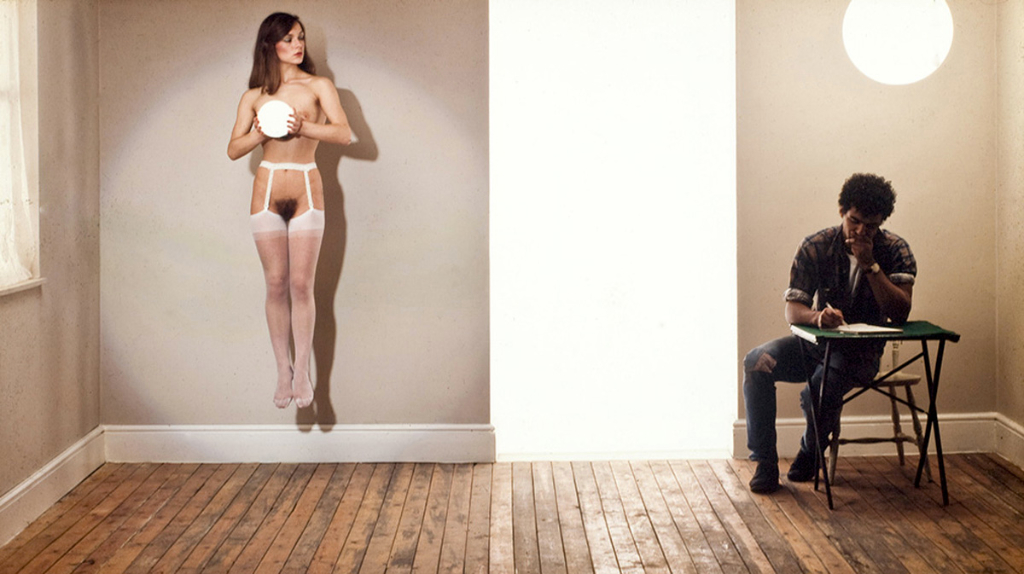
This extraordinary photograph is a two shot double exposure. An out of focus mask, placed in a registered frame in front of the lens was arranged to divide the image more or less in half following the centre line of her body and out via her right shoulder. The model then very carefully moved her lower leg from the right to the left between the two exposures. She had to be very careful to keep everything else in place. Not at all easy to do. – Circa 1977

(The Isle of Man has a three legged symbol on its flag)

Phurnacite

Five exposures on a single piece of film were needed for this photograph. I used a sheet of expended metal  with the ability to reflecting light at an angle. I could then light the briquette such that the shadow is on the left while the light that creates it is reflected toward the lens. Added to this was the “laser” line and star, reversed out of a black sheet of litho film and exposed through a soft focus filter with a red gel. A third exposure was a tiny light bulb hidden just behind the coal also exposed through a soft focus filter. The forth exposure lit the background and the final exposure was a red filtered spot light to create a red glow on the coal itself. – 1983

Fina Heart

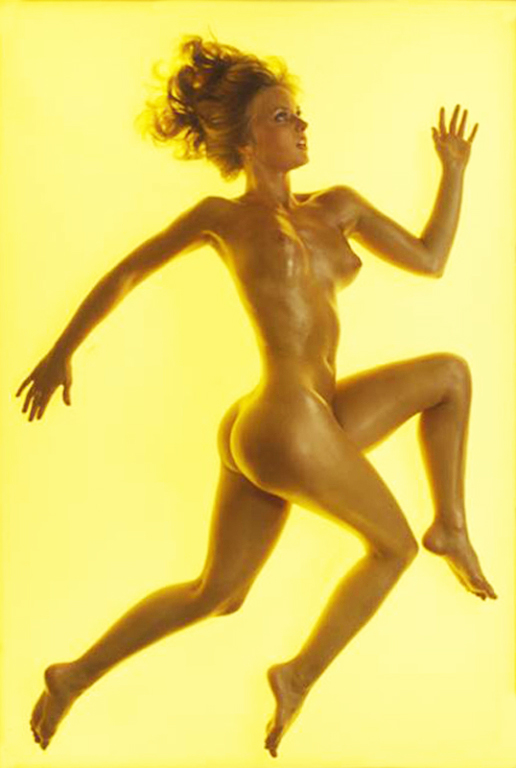
Agency: CPS – AD: Barry Bendel – Client: Petra Fina. == Lighting, model making and very thick oil were all that was required to create this image on tungsten 10 x 8 inch film. The glowing skin was featured on the layout but no one was sure exactly how to create the effect. In the end we simply cut an oversized outline in translucent perspex (plexiglass) and back light it with yellow light by cutting a similar hole out of the background. Superbly model made by Alex Minca of Parallax Modles.

Fina Head

Agency: CPS – AD: Berry Bendel – Client: Fina. == One model, two shots.

Pioneer

Agency: AMC – AD: Martin Neagus – Client: Pioneer. == The first page in the 1987 Pioneer catalogue shows, apart from the entry model stereo system, an empty room and a full painting. This, the second page, captures the furniture beginning to migrate out of the painting.. As the catalogue progresses, more and more items float out of the painting and position themselves in the room until the painting is empty and the room is full.  All the objects are rigged on fine fish line or hidden armatures. – Jan 1987

The Impact is Enormous

Client Armitage Shanks == How? The obvious: The set is built upside down. Further refinements were necessary of course including fitting Perspex (Plexiglas) nozzles to the taps to direct the water straight up (down) and a hell of a lot of finishing work on the floor (ceiling).  Background painting by Gordon Aldred – April 1985.

Clockwork Orange

Client: Fybogel  == This is a double exposure of a carefully rigged setup. The background is a sheet of opal Perspex, backlit through angled gels to create the blue graduation. The clock is held on an armature rod which extends through the Perspex. I built a framework of brass strips and drawing pins on the armature and the clock to hold the carefully cut orange peel. The shot was double exposed because the Perspex needed to be covered in black velvet for the foreground shot to prevent the front lighting from casting shadows. – May 1990

Form Design

Agency: George Heines == Art Director: Lloyd Hancock – Client: Form Design. ==
One of my first shots on 10×8 film, this was great fun to create. The surface is a 4 foot deep light box covered with a litho film perspective grid and a green filter. The back ground is painted, The foreground forms are full size pages mounted on armatures coming from the background. Middle ground forms are 1/2 size models dangling on fish line and top distant forms are painted into the background. – Circa 1983

Diner with Dali

Photographers Do It Both Ways == Association of Photographers Exhibition:  Martin Neagus and I switched rolls with me as art director and Martin as photographer. Well we did it but slipped back into our more comfortable rolls from time to time when required.
Everything is rigged including the wine glass which is welded to a glass tube through the back of the painted wall. Liquid was blown through the tube and the flash fired. – Circa 1987

Exploding Light Bulb

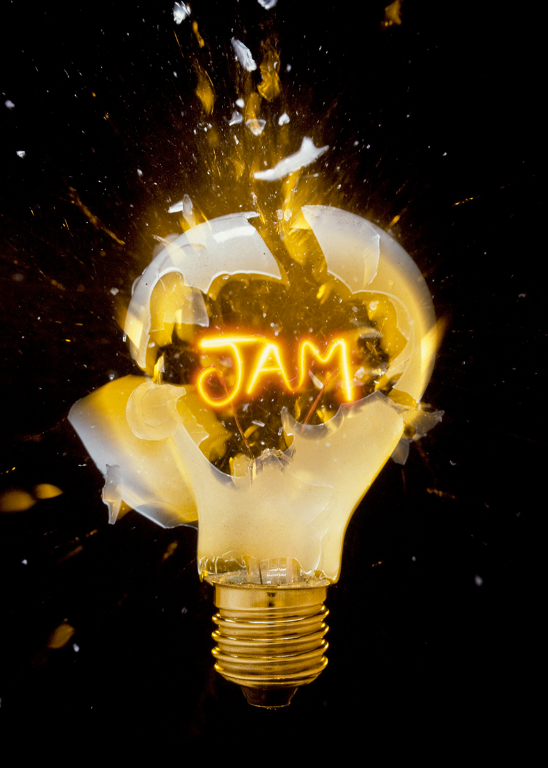
Personal work == This image took some time to create requiring three exposures on a single piece of film and a lot of practice. The glass was first removed by heating the base and dipping it water. The “JAM” logo, my initials, was hand made in resistive wire, powered to glowing using a variable transformer and exposed in the dark for several seconds through a soft focus filter. The glass was then replaced and a bit of extra glass positioned in the centre as a target. A tied off pellet gun was used to shatter the glass target and a microphone under the bulb triggered the firing of the flashes. The first flash, with a yellow filter, was a fairly slow, 200th sec, studio unit. A few milliseconds later a second unfiltered flash was fired. This was very high speed unit, about 10,000th sec, which froze the bits. My home made timing circuits were highly adjustable and the shoot was repeated about 50 times making small adjustments each time until the desired result was achieved. – Circa 1980

Wrecking Ball v Anti-Virus

Agency: Grey Direct – AD: Vic Hazeldine – Client: CP Software == Similar to the exploding ship and exploding computer, this is shot using a rigged set. The pre broken wrecking ball and broken bits are held in place on invisible black armature rods. Compressed air launches small bits and dust through the set just before the Flash is fired. The strong back lighting emphasizes the explosive effect. Model making by Parallax. – Dec 1992

The Guardian

This young radar operator was lit mostly by light from a large lightbox under her face. The reflection patterns were drawn with black ink on white paper and then photographed and reversed onto a 3 foot wide piece of black litho film place over a lightbox. Coloured filters under the patterns completed the effect.

The Trader

The Trader. This image is shot in a similar way to the RAF recruiting poster above. the data is artwork reversed out of a large piece of litho film covering a light box underneath the traders face. To achieve the colour, filters are placed under the film. – 1989

Heads or tails?

Created for the Telegraph Library – Now Getty Images == This animated classic image is shot on a single sheet of 10 x 8 film. 11 exposures were necessary, one for each coin position and 1 for the star on the top one. The coin was mounted on a black armature attached to the black background, The camera and / or the coin were moved and rotated for each exposure. – 1984

The Thing Perhaps?

Personal work == This image required two exposures through a complex set of soft focus masks. The top shot shows the hand and upper shadow while masking the model lying underneath with his hand through the cut out bottom. The lower shot completes the image while masking out the supports holding the case up. Extreme accuracy is required for this kind of effect.  I must say, I was rather pleased with it. – 1984

Pepe Supernatural Denims

This was a fairly simple set built up off the floor so it could be lit from underneath. A bit of smoke and lighting does the effect. The models are made to float the easy way. If you look closely you may be able to detect the thin steel cable which is holding them up. – Circa 1977

Pepe Supernatural Denims

Shot on a single sheet of 10 x 8 film, this image is a good demonstration of the accuracy of my home made pin registration system. The “Lightning bolt” is created as a piece of art work black on white. It was then reversed into a 24 inch piece of litho film and double exposed through filters onto the shot of the models. The “bolt” fits perfectly between the rigged broken light bulb and the wall socket. – Circa 1977

Washable Wallpaper?

Agency: Broadbents – AD: Terry Melton – Client: Homebase = As it turned out, by using a bit of lateral thinking this was fairly easy to do. The far left watering can’s nozzle was plumbed through the paper and real water was run through a full size rose during the single flash exposure. Because water droplets have obvious scale it was necessary to make the wallpaper much larger to match. In this case the ‘wallpaper’ was created on a 9 foot wide roll of yellow background paper using green and white rubdowns to make the pattern.
National 48 sheet posters – 1987

The Idea

This was a further experiment using my in-camera soft mask system. I created a mask plane inside my 5×4 Sinar such that two pin registered masks would cut the image more or less in half just above the girls knees. She stood on a box when I expose the top half and was supported by a harness to expose her lower legs. The trick is to get everything lined up so the two halves match up properly. Very easy to get wrong. – 1982

The Photographer

To achieve the hard edge where the camera joins the neck, I positioned a sheet of brown card in front of my besuited assistants face.  The soft edge of the mask merges the camera edge with the brown card.  My assistant in question  was the young Max Vadukul who went on to become an internationally famous reportage photographer in New York City some years later. – 1980