

The Kelly Creek Fire
Idaho 1961
By Jay Myrdal
I graduated from High School and turned eighteen in June of 1961 in Missoula. Montana. Up to that time, I had been too young to get a proper job, having to satisfying myself instead with delivering purchases for our local Fuller Brush man, selling greeting cards door to door, or mowing lawns. I was always anxious to earn more money and now I was old enough to get a proper grownup job. While looking for the above I heard that they were hiring bodies to fight a forest fire that had just broken out in the Kelly Creek region of Idaho. I applied and was immediately hired, they were taking anybody, even the local winos.

I had time to pick up some boots and clothes and probably a sleeping bag from home and turned up an hour later at the despatch point where we were loaded into the backs of open trucks and set off for the Lolo pass and the Clearwater River into Idaho. The fire was over a hundred miles away and we bounced around in the back of our truck for a good three or four hours before finally arriving at a camping area, apparently the headquarters of the fire defence operation. That said, I could see no sign of a fire or even smoke anywhere. We settled into our tents, had a meal, and were set to repairing an existing fire break nearby.
The next morning, we were organised into teams and instructed to march off into the woods. We were in the mountains but still well below the tree line. The seat of the fire was apparently below our position, so we descended down a long ridge, following our crew boss, toward the burning area. Our crew boss was a Montana State University graduate student and was studying forestry. He was very fit and gung-ho and very hands on when it came to fire fighting. He had been issued with a walkie talkie for the crew, but he didn’t want to be encumbered with it so made me the radio operator. I had had some experience with radios having been a member of my high school, closed circuit, radio station.
As we were walking down a ridge, I heard some chatter on the radio and realised that two of the crews were attempting to talk to each other, but the undulating terrain prevented them from doing so. I was on the ridge and could hear and speak to both, so I offered to relay their messages. The procedure took some few minutes while the rest of the crew waited for me a bit further down the ridge. Suddenly I heard a shout and looked over to see them scurrying away from a falling tree. It wasn’t my fault, but it was concluded that I should be demoted back to ordinary fire fighter and my radio was taken away. (sigh)


During all this the fire was lazily burning along the ground in the pine needles and leaf litter to our right and was apparently safely contained behind a narrow fire break which had been scraped into the forest floor. The tool for doing this was the Pulaski, a clever wildfire fighting instrument consisting of a shaft with a double-sided head; a small axe on one side and a flat hoe like blade on the other. The Pulaski was perfect for scrapping a fire break into the ground or chopping away any small trees or dead falls in the way. We were all issued with one of these useful tools.
As we descended the mountain it appeared that the fire had been largely contained and every hundred metres or so was a man with this useful tool in his hands, casually adjusting the line and keeping an eye on the fire behind it.
At one point our crew turned off the ridge to the right and down the steep side of the mountain following an established fire line until we came to a section that still needed attention. We were instructed to continue to extend this little fire break, only a foot or so wide, downhill to complete the containment. After an hour or two we met up with another crew doing the same thing from the opposite direction, and we settled down to contemplate our work. The fire break seemed to be doing its job, and the fire didn’t burn any further than this little boundary.
One of the older guys in my crew was getting bored and motioned to me to come with him. We told our crew boss that we were “Going to inspect the fire line”. I guess this was just a subtle version of skiving off, but I had little else to do so I followed him, and we walked up the hill following another line of the fire break. The hill was rather steep, and I had my head down in hike position, which meant that I was only looking at the ground and the rising steep trail in front of me. As we got higher and higher, I began to hear a low rumbling or growling sound, distant at first then louder and louder. I stopped and looked up. Above me but coming from the other side of the mountain was a massive cumulous cloud, fluffy white at the top but dark, waterlogged, and glowing bright orange below. By this time, we were only a couple hundred yards from the top of the ridge. As we continued to climb, the noise got louder and louder, and the glow at the bottom of the cloud got brighter and brighter.

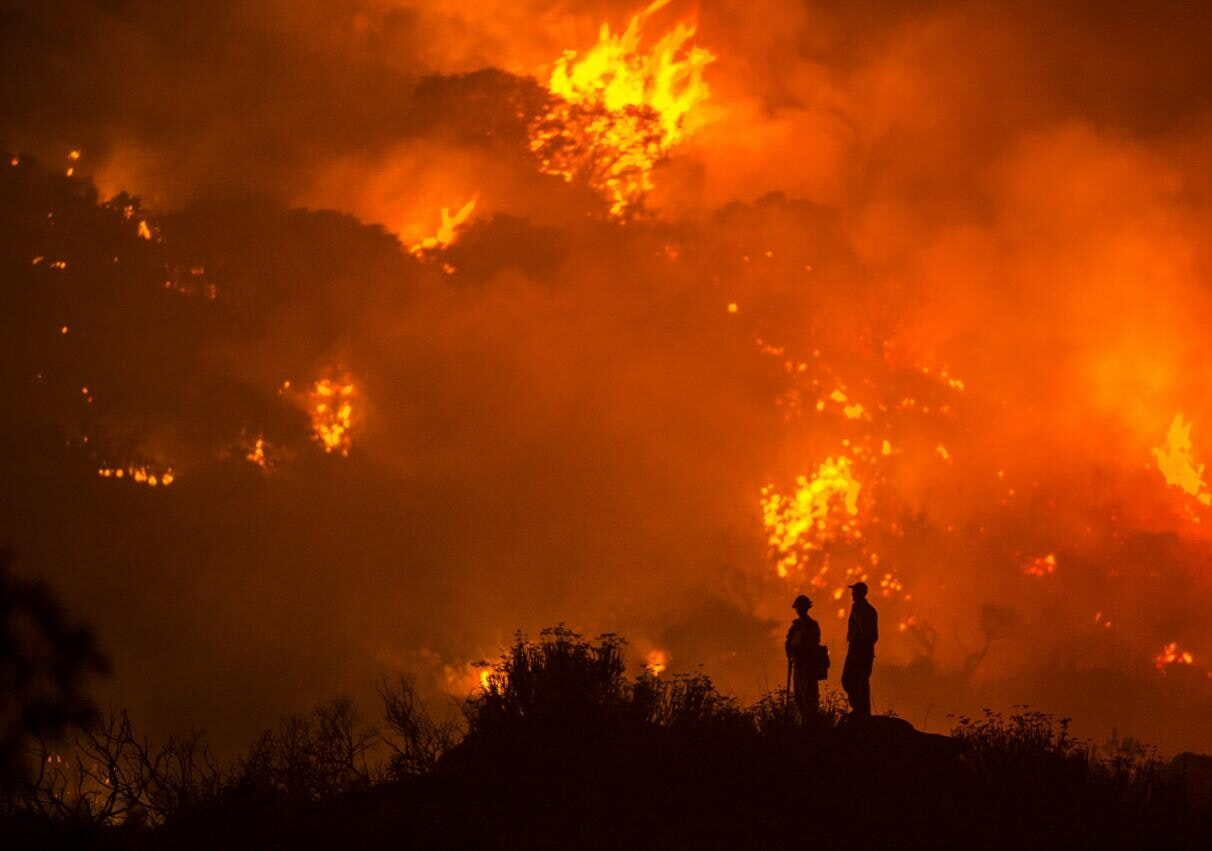
On reaching the top of the ridge, I found a group of about twenty-five men standing or sitting in silence, watching the mountain on the other side of a small ravine. The whole side of the next ridge, which was only about eight hundred yards away, was completely in flame; we could feel the hot radiation on our faces. The fire on that side of the mountain had “crowned”. That meant that instead of burning quietly along the ground as before, the fire had got into the crown of the trees and had become a huge conflagration. Although it wasn’t overly windy, the immense heat created its own draft and fanned the flames into a fire storm. The fire was rolling up the mountain on the other side of the ravine, flames forty or fifty feet high, then falling away and rolling back down the slope. Moments later another huge tongue of flame would emerge to repeat the terrifying display, now licking even further up on the mountain side. From time to time, I would see bits of bark and tree branches flying out of the maelstrom closely followed half a second later by a loud boom as a tree, having been heated well past boiling point, exploded when the sap, now steam, had no other way to escape. It was mesmerising and I stood there transfixed for a few minutes, captivated by the extraordinary display in front of me.
While there didn’t seem to be any immediate danger, I began to think that this fire could perhaps find its way over to our side of the ravine and it might not be a good idea to stay here very long. We contacted our crew boss and were given permission to hike back up the ridge the way we came and back toward base camp.
It was quite a hike; we had walked down the ridge further than I had imagined. I was back in my montana hike mode and climbing at a nice steady pace. The climb took the better part of an hour, but I was in no particular hurry, I didn’t see any sign of the fire behind me so there didn’t seem to be any need to rush. I guess that wasn’t the case for everyone, and as I climbed steadily, I was occasionally overtaken by other men, breathing heavily, climbing rapidly and in earnest. The closer I got to bass camp the more exhausted fire fighters overtook me in their eagerness to out pace the fire which, although I could still see no sign of it below, must have moved over to the ridge we were on. I later discovered that the remainder of my crew had been among the ones who needed to hurry up the hill more quickly than they would have liked.
Not long after that I arrived at base camp to discover that, surprising, all was calm there. I didn’t get any further details, but although I believed we were higher than the fire below on the ridge, and it is well known that a fire likes to burn uphill, it didn’t seem to be presenting any danger to the camp.
The fire camp had become a large operation by now. I would guess upwards of two or three hundred people. There were lots of tents dotted around; for sleeping in and for use as command-and-control centres. There were also several cook tents to make meals for the men.
I have forgotton just how it came about but that energetic climbing and descending of mountains, all the while keeping a close eye on the fire, was losing its appeal. Some how I managed to talk myself onto the cooking crew. My first job was to break about three hundred eggs for the mornings breakfast. That was great fun and I quickly learned to crack eggs four at a time, two in each hand, mostly without breaking the yokes and without leaving too many shells behind – well not once I had got the hang of the technique anyway. The first few dozen? Well, a boy must learn somehow.
Working in the cook tent was great. Much more convenient of course but more importantly it didn’t involve all that hiking and hacking. I would get up very early in the morning and spend a few hours making sandwiches for the crews. This was done by laying out a whole loaf of white bread in two rows of slices and slapping a bit of butter on each slice: then going around dolloping a spoonful of jam onto the slices in the bottom row and a slick of peanut butter on the slices in the upper row. The two haves would then be slapped together, wrapped in a bit of waxed paper, and thrown then into a paper bag. I guess we also used lunch meat and mustard and perhaps other combinations, but the assembly method was always the same. Fortunately, we could eat what we liked from the provisions found in plentiful amounts in the cook tent.
While it looked like the fire was more or less contained from my observations on the first day, the flare up that I witnessed, and others caused the fire to take hold again and, in the end, we were there for eighteen days
Because we had to get up early to make the sandwiches and worked late into the evening to wash up and get ready for the morning, each shift was about 18 hours long. Well, that was just fine, as it still left eight hours for sleep and what else was there to do after all. The great thing was that we got paid by the hour. The rate of pay was a $1.85 an hour which was only just short of what I could have got in a sawmill at eighteen years old. It doesn’t sound like much now, but it was more than I had ever earned before. So, eighteen hours times eighteen days, and a quick thumbnail calculation reveals a cash-out total of nearly six hundred dollars. For an eighteen-year-old Montana kid in 1961, it was a fortune.
I must have had further finances stashed away because not long after that I went down to West Broadway on the way out of town, where for the last few weeks, a black 1952 MG TD with a red tartan soft top, had been parked next to a fruit stand with a for sale sign on it. My best buddy Mick already had one of these lovely classic cars, and I wanted one too. I think I paid seven or eight hundred dollars for it which was probably a bit overpriced, considering it had sat on that lot for some time. Nevertheless, it was a great little car and I thoroughly enjoyed driving it around for the next year and a half until I left home for the Army.
We found out later that a small professional native Indian crew had sadly been killed in general vicinity of the mountain side which I had watched burn so ferociously . Very tragic it was, and further proof of how dangerous and destructive forest fires can be. Perhaps it is worth mentioning here that forest fires have been with us for as long as we have had forests.
Sadly, we are now learning that climate change is making things worse and will continue to do so for many years to come.
<->
Note: All the photographs above have come courtesy of the internet but the images perfectly fit my memory of event.
One Comment
Jay Myrdal
This memoir was written sixty one years after the fact, and memory being what it is, some of the above may not be correct. If you have any knowledge that differs from mine, I would be very grateful if you post it here or contact me otherwise. It would be good to get the record straight.
Thanks…
Jay